Kreepy Krauly Troubleshooting Tips
Because of the individual characteristics of your pool, some additional adjustments may be
required to get the best performance from your Kreepy Krauly.
If there seems to be a problem, check these common causes of cleaner problems. If you still need help, call your
pool professional or call our toll-free Customer Helpline at 1-800-443-5711.
— Is bottom main drain closed? Close drain
— Is filter clean? Clean filter
— Is pump strainer basket clean? Clean basket
— Is debris blocking the bottom of Kreepy Krauly? Remove debris
— Are there any leaks in the hose? Replace leaky section
— Is automatic regulator valve free of debris? Clean valve
If Kreepy Krauly is not moving or not pulsating.
• Check to ensure that the main drain and all
suction lines are closed, except for the suction
line to which Kreepy Krauly is attached.
• Check for debris in the filter or pump basket.
• Check for debris in Kreepy Krauly’s flapper. Debris may prevent flapper movement or
restrict flow. See page 13 for instructions.
• Pool pump and filter system may be too small (incapable of providing 25 gallons per minute
water flow). Consult your pool professional.
If Kreepy Krauly stays in one end of the pool.
• Check the return line water flow and redirect
as necessary with an eyeball diverter.
• Check that hose is long enough to reach to end of pool.
• Check that Kreepy Krauly has proper hose balance.
If Kreepy Krauly stays on the main drain.
• Check to ensure that main drain is closed. A pool
professional may need to assist you.
• Check to ensure that a main drain grate is installed.
• If main drain is not flush with the pool floor, consult your pool professional.
If Kreepy Krauly slows or stops and air bubbles enter the pool at the return line.
Find and
correct the air leak that is causing the pump to lose its prime:
• Check the hose to ensure there are no leaks.
• Check the vacuum connection. It should be submerged so no air enters the system.
• Check the pump basket lid for looseness, cracks, and worn or missing O-rings. If you need
assistance, contact your pool professional.
If Kreepy Krauly is moving too fast.
In most pools, the automatic regulator valve supplies
Kreepy Krauly with the proper amount of water flow. However, if used with an especially powerful pool pump, the
valve can be
overpowered.
• To slow Kreepy Krauly down, a manual by-pass valve (Part #K12094) accessory is available for purchase from your
Pentair Pool Products dealer. This manual by-pass can be adjusted to achieve the recommended cleaner speed of 8 to
12 feet per minute.
• To decrease the speed of Kreepy Krauly, simply remove the in-line valve cone from the bottom of the automatic
regulator valve and replace it with the manual by-pass as shown in Figure 15.
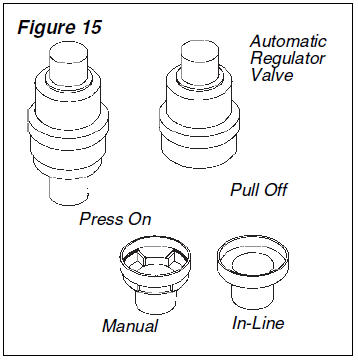
• Press the automatic regulator valve into the threaded compresion adapter (or 2" hose cone if used). The end of
the valve that is marked “Attach Hose This End” must point up.
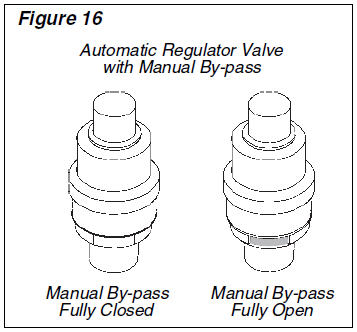
•Adjust the manual by-pass while the Kreepy Krauly is running. Place your hand into the skimmer and turn the
by-pass adjuster one click at a time until the desired speed of 8-12 feet per minute is reached. See Figure 16.
If Kreepy Krauly pulls air from, or remains at, the water surface.
• Check to ensure the dive
float mechanism is operating freely and the dive float restrictor is
installed. (See page 4 for how to install dive float restrictor.)
• Check the automatic regulator valve for its proper installation and ensure it is not clogged
with debris.
• Make sure the water level is at least 3 inches below the pool deck.
• Check to ensure your Kreepy Krauly is operating at the proper speed of 8-12 feet per minute.
If Kreepy Krauly stays at the shallow end steps.
• Check the return line water flow and
redirect as necessary with an eyeball diverter.
• Check the automatic regulator valve for its proper installation and ensure it is not clogged
with debris.
• Check that hose is long enough to reach the furthest point of the pool, including pool steps.
• Check that Kreepy Krauly has proper hose balance in shallow end.
• Check to ensure your Kreepy Krauly is operating at the proper speed of 8-12 feet per minute.
• Check to ensure the dive float mechanism is operating freely and the dive float restrictor is
installed. (See page 4 for how to install dive float restrictor.)
• Shorten the roller bumper strap by 1⁄2 inch. (Pull out upper end of bumper strap from locking end clip attached
to swivel head. Cut 1⁄2 inch off, then return bumper strap into locking end clip.)
If Kreepy Krauly tracks in a repetitive pattern.
• Check the swivel on the
top of Kreepy Krauly. It should turn freely.
• Check the return line water flow and re-direct as necessary with an eyeball diverter. Refer to page 9.
• Check Kreepy Krauly’s hose to ensure it has not become bent or kinked. It only takes one bent or kinked hose
section to hinder the cleaning coverage. One way to check for kinks in your hose is to lay each section flat on
your pool’s deck (or other flat surface). The hose
should be perfectly straight and flat. Do not coil the hose when taking your Kreepy Krauly out of the pool because
it will retain the coil shape, forming a bend or kink.
If Kreepy Krauly gets stuck on pool obstructions such as a safety ledge, ladders, steps, swim-outs,
benches, etc.
• Remove dive float restrictor and install a wall climb adjuster (Part #K12065). Snap the
wall climb adjuster into place as shown in Figure 17.
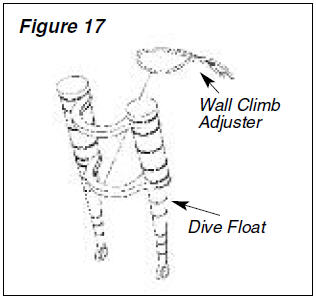
This will keep Kreepy Krauly on the pool’s floor and away from pool obstructions. Make sure
the narrow end of the wall climb adjuster points down to the drive tubes.
If Kreepy Krauly gets stuck under your pool ladder, install a
Ladder Guard (Part #K12330) according to the instructions
contained in the packaging. (These accessories are available
for purchase from your Pentair Pool Products dealer.)
To Remove Debris From The Kreepy Krauly Flapper
• Sometimes debris may clog the bottom of the
cleaner and prevent flapper movement or restrict flow. The flapper is located inside the main body and must move
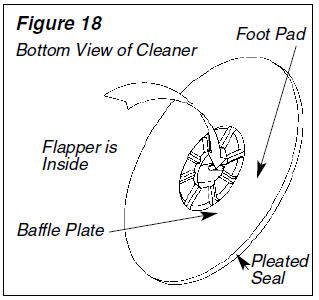
freely at all times. You can see the flapper through the opening in the baffle plate, when you turn the cleaner
upside down as shown in Figure 18. Jiggle the flapper with your finger or flush the cavity with a hose to force out
any debris lodged inside the main body.
• If debris is still lodged inside, you must remove the flapper.
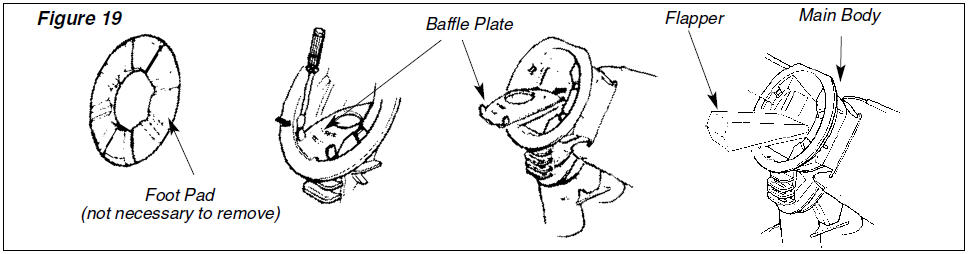
First, lift the lip of the foot pad and insert a flat-head screwdriver along side one of the two tabs found on the
baffle plate. See Figure 19. Push the tab inward with the screwdriver until the baffle plate releases. Place a
finger into the center opening of the baffle plate and pull up until it pops out. Then pull the flapper out.
NOTE: You should be able to do this without taking the foot pad off.
• Once the debris is
dislodged, insert the flapper back into the main body and snap the baffle
plate back into position. Be sure that it is securely in place. See Figure 19.
|